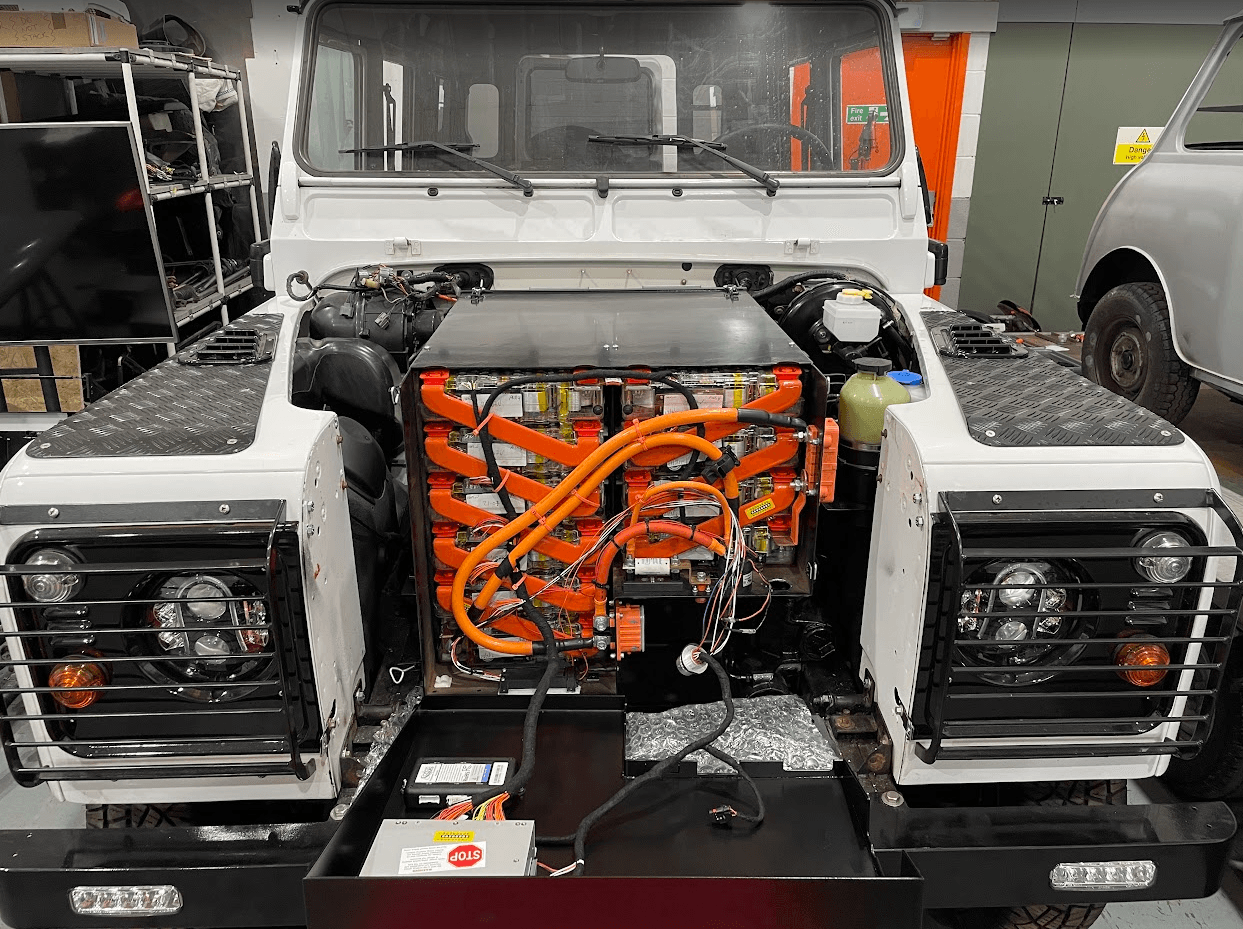
A classic car EV conversion can be reliable and enjoyable, but only when the safety systems are designed properly. High voltage should never be treated as just a bigger 12V system.
The main goal is simple: the vehicle should only energise the high-voltage system when it is safe to do so, it should shut down when a fault is detected, and it should be possible to inspect and diagnose the system later.
High-voltage cable routing
High-voltage cables need to be routed, protected and labelled correctly. They should be kept away from sharp edges, heat sources, moving parts and areas likely to be damaged by road debris. Visible high-voltage cabling is normally identified with orange insulation or sleeving in modern EV practice.
Good routing also makes the vehicle easier to inspect. If a cable disappears through a chassis rail with no protection, no strain relief and no access, future maintenance becomes much harder.
The BMS is not optional
The battery management system is one of the most important parts of an EV conversion. It monitors cell voltages, temperatures and limits. It should be able to request reduced power, limit charging, stop the vehicle from starting, or open the contactors if the battery is outside safe limits.
A conversion that has no proper BMS, or a BMS that cannot communicate limits to the rest of the vehicle, is not a professional solution.
Contactors, precharge and fusing
The high-voltage battery should not simply be connected directly to the inverter and charger. A proper system uses contactors to connect and disconnect the pack, precharge to safely charge inverter capacitors before the main contactors close, and fusing to protect against excessive current.
The precharge process should be controlled and monitored. If the voltage does not rise correctly, the system should not close the main contactors.
Isolation monitoring
Isolation monitoring helps detect whether the high-voltage system has an unsafe leakage path to the vehicle chassis. This is especially important in classic vehicles where moisture, old metalwork, custom battery boxes and mixed materials can increase risk if the design is poor.
An isolation fault should trigger a safe response. At minimum, the system should warn the driver and prevent continued use depending on severity and design intent.
Thermal safety
EV components generate heat. Batteries, inverters, motors, chargers and DC-DC converters all need to stay within their operating range. Temperature sensors should be used where they matter, and the control system should be able to reduce power or stop charging if limits are exceeded.
A car that works during a short test drive may still fail on a hot day, during fast charging, or during sustained motorway use if thermal management has been ignored.
IVA and approval considerations
For UK vehicles, approval and registration requirements depend on the vehicle, its age, whether it has already been registered, and the scale of modification. Current DVSA and GOV.UK guidance should always be checked before committing to a build route.
For electric and hybrid vehicles, the relevant inspection route may include electrical safety evidence when the operational voltage is above 48V. This is one reason early project planning matters. It is much easier to build with compliance in mind than to repair a poor installation afterwards.
Documentation helps safety and value
A professional conversion should include documentation. At minimum, the owner should know where the service disconnect is, what battery modules are fitted, what BMS is used, where the fuses and contactors are located, how the cooling system works and how to read faults.
Documentation is also useful for future owners, insurers, MOT testers and workshops. It adds credibility to the build and reduces the risk of the vehicle becoming impossible to support later.
Poor safety design is expensive to fix
Many unfinished or poorly built conversions are not let down by one failed part. They are let down by poor system architecture: no clear shutdown logic, no diagnostics, poor HV routing, weak battery mounting or no service access.
At VASS Technology, we support new EV conversions as well as rectification work on existing conversions. Our focus is to make the high-voltage system understandable, serviceable and safe to operate.
Need help reviewing or rectifying an EV conversion? Contact VASS Technology for high-voltage system support.
FAQ section
Does a classic EV conversion need a BMS?
Yes. A proper battery system should use a BMS to monitor cell voltages, temperatures and operating limits, and to protect the pack during driving and charging.
What is precharge in an EV conversion?
Precharge is a controlled process that charges the inverter or charger input capacitors before the main contactors close. It helps prevent damaging current spikes.
Do EV conversions need isolation monitoring?
For high-voltage conversions, isolation monitoring is strongly recommended and may be required depending on approval route and vehicle type. It helps detect unsafe leakage paths between the high-voltage system and chassis.
Does every classic EV conversion need IVA?
Not always. UK approval requirements depend on the vehicle, its registration status and the extent of modification. The current GOV.UK and DVSA guidance should be checked for each project.